

What is the Cost of Starting a Supplement Company?
Introduction
How much does it actually cost to start a supplement company in Malaysia? The honest answer: it depends entirely on your business model. Go the private-label route with an existing formula, and you can enter the market on relatively low capital. Choose proprietary formulation or in-house manufacturing, and you’re looking at a far steeper investment.
The manufacturing quote is just the tip of the iceberg. Malaysian founders also need to consider NPRA registration, testing, labelling, branding, marketing, inventory, and fulfilment. In this article, we break down the cost of starting a supplement company to help you understand what it takes to bring your product to market.
Costs Involved in Starting a Supplement Company
1. Product Development and Testing Costs

Product development costs vary by business model. Private-label products typically require less upfront R&D.
On the other hand, custom supplements may involve ingredient and dosage selection, formula design, prototypes, stability and compatibility testing, microbiological or chemical testing, and sample revisions. This is why custom formulation and R&D can reach RM5,000–RM30,000+, depending on product complexity.
2. Manufacturing Costs
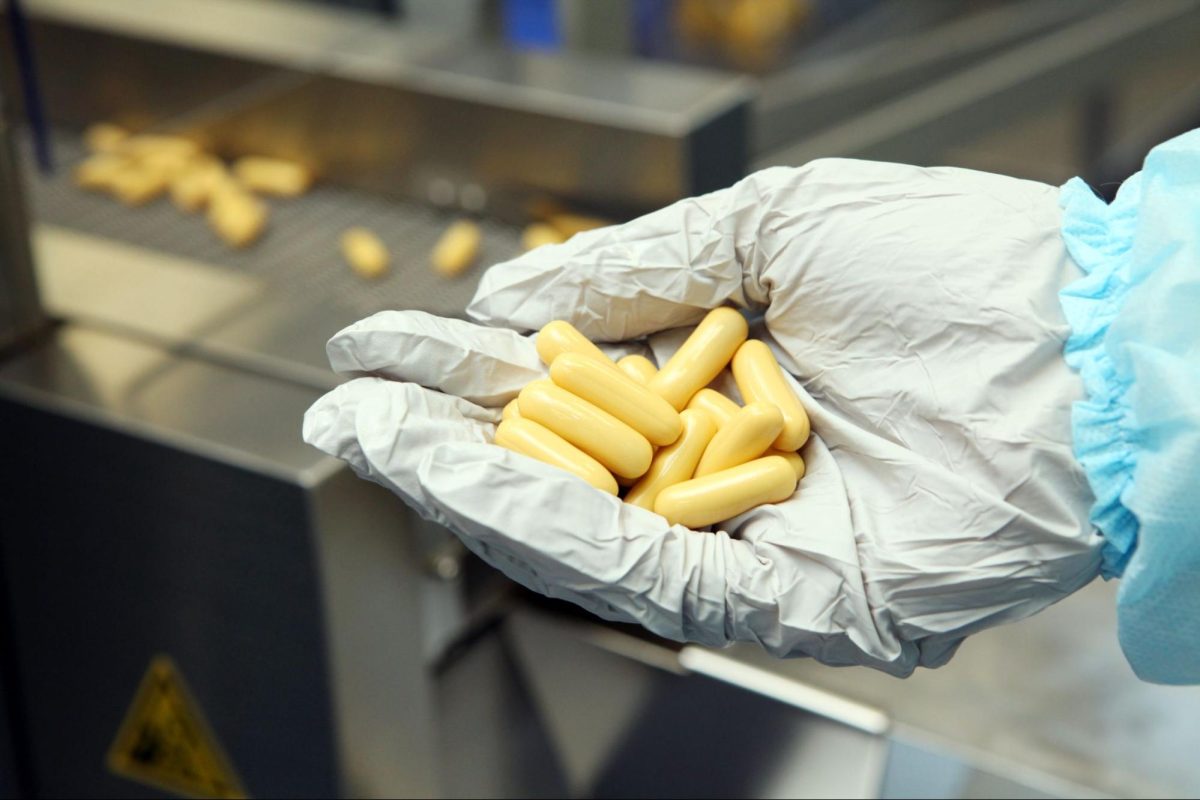
Manufacturing is usually one of the highest variable costs because the amount paid depends heavily on the product specification and production quantity.
Important variables that influence this cost include:
- Formula: The ingredients, dosages, and number of active ingredients influence the manufacturing cost.
- Dosage form: Capsules, tablets, powders, gummies, and liquids have different manufacturing processes and packaging requirements.
- MOQ: A manufacturer may require a minimum production quantity. A lower unit cost at a larger volume is not necessarily beneficial if the business cannot sell the inventory quickly.
- Ingredients: Raw material prices can vary substantially between ingredients, grades, origins, and specifications.
- Packaging: Bottles, sachets, blister packs, pouches, and cartons each have different material, printing, and production requirements.
- Labelling: The label must accommodate the relevant product and regulatory information rather than simply serving as a branding asset.
The manufacturing quote should therefore be evaluated as more than a simple cost per bottle. Always ask your manufacturer what is included in the quotation.
3. Regulatory Compliance Costs

Regulatory compliance should be treated as a core product-development cost, not an administrative task added at the end. In Malaysia, health supplements fall under the regulatory framework administered by the National Pharmaceutical Regulatory Agency (NPRA).
A. Product Registration
A company should determine the regulatory classification of its product before committing heavily to formulation, packaging, and marketing.
Registration costs can include official fees, regulatory support, documentation, testing, and ongoing maintenance such as re-registration.
B. Label Compliance
A label has to do more than communicate the brand’s identity. It must also provide required product information, ingredients, directions, warnings, and other applicable regulatory details. Reviewing these requirements before printing can help avoid redesign costs, delays, and compliance issues later.
C. Advertising and Claims
Marketing claims require particular attention because a claim that works as ordinary brand copy may have regulatory implications when used to promote a health supplement.
Advertising compliance is an ongoing cost. It applies to website copy, social media, paid ads, influencer campaigns, packaging, and other customer-facing communications.
D. Legal Infrastructure
Legal costs can include company incorporation, corporate secretarial services, trademark registration, contracts, regulatory advice, intellectual property protection, product liability insurance, and ongoing legal counsel.
Some of these costs are upfront, while secretarial services, insurance, and legal advice can become recurring costs.
4. Branding and Market Entry Costs

Having a compliant product does not mean customers will automatically find it. A supplement company also needs to build a brand that communicates who the product is for, what problem it addresses, and why the product is credible.
Branding and marketing costs are both one-time and ongoing. Brand identity, packaging design, and website development are largely upfront, while advertising, content creation, and customer acquisition continue after launch.
Initial branding and website costs may range from RM3,000–RM15,000, with an initial marketing budget of around RM10,000–RM50,000+, depending on the launch strategy.
5. Operations and Fulfilment Costs

Once the product is manufactured, the business still needs to store, move, and deliver it. Costs can include inventory storage, fulfilment, customer service and quality management.
Warehousing and fulfilment can start around RM5,000 and exceed RM20,000 in the first year, depending on order volume, storage needs and whether you use a 3PL or manage fulfilment in-house.
How Much Inventory Should You Keep?
There is no one-size-fits-all inventory level. New brands should keep a small buffer beyond forecasted sales to reduce stockout risk. The right amount depends on MOQ, lead time, sales speed, shelf life, and storage costs.
Keep your stock buffer and cash reserve separate. Extra inventory helps meet demand, while several months of cash covers payroll, marketing, software, fulfilment, and the gap between paying suppliers and receiving sales.
6. Technology Infrastructure
Technology costs are easy to overlook because individual subscriptions may seem inexpensive. A supplement company may need e-commerce, payment, inventory, accounting, customer management, marketing, and analytics tools, along with related hosting and security services.
These costs are mostly recurring. Choose technology based on the company’s current needs and scale, rather than investing in expensive systems before they are necessary.
What Is the Overall Cost of Starting a Supplement Company?
There is no single figure for the overall cost of starting a supplement company in Malaysia. However, use this table as a rough guideline on the indicative startup costs for different supplement business models:
Launch model | Indicative starting cost | Product development |
Private-Label / White-Label Dropshipping | RM10,000–RM40,000 | Low, using pre-formulated products and stock packaging |
OEM Supplement Manufacturing (Turnkey) | RM40,000–RM120,000 | Medium, with your branding and the manufacturer’s standard or adapted formula |
Custom Formula Development | RM80,000–RM250,000+ | Higher, with custom formulation, R&D, testing and development |
In-House Manufacturing | Significantly higher | Highest, with your own facility, equipment and manufacturing systems |
The biggest cost drivers are usually the formulation and active ingredients, MOQ, packaging requirements, testing, regulatory work, and the amount of working capital you need to carry inventory and fund the business after launch. Manufacturing is therefore only one part of the overall cost.
Different Types of Supplement Company Models and Their Costs
1. Private-Label/White-Label Dropshipping
A private-label/white-label dropshipping model can reduce the need to purchase and store large quantities of inventory upfront. The business selects a pre-formulated product from a private-label or white-label manufacturer, applies its own branding, and relies on the supplier or fulfilment partner to ship orders.
The trade-off is that the company has less control over formulation, production, and fulfilment.
2. OEM Supplement Manufacturing
OEM manufacturing allows a brand to partner with an established third-party manufacturer to produce health supplements according to its specifications, without owning a manufacturing facility. The manufacturer handles the production process, while the brand manages areas such as product requirements, branding, inventory, marketing, and distribution.
This gives the company more control than a private-label model while avoiding the significant capital investment and operational responsibilities of running an in-house manufacturing facility.
3. Custom Formula Development With a Manufacturer
For founders who want a differentiated product without owning a factory, custom formula manufacturing is often the middle ground.
The company can collaborate directly with the manufacturer to create a custom formula. This offers a practical balance between product differentiation and capital efficiency without the investment required to build an in-house manufacturing facility.
4. In-House
An in-house model gives the company the greatest control over formulation, production, quality, and operations, but it also requires the most capital. Beyond manufacturing equipment, the business needs to invest in a suitable facility, quality systems, regulatory compliance, raw materials, storage, utilities, and skilled staff.
This model is generally more suitable for established companies with sufficient production volume to justify the upfront investment and ongoing operating costs.
Supplement Company Models and Their Cost Comparison
Cost consideration | Private-Label / White-Label Dropshipping | OEM Manufacturing | Custom Formula | In-House |
Upfront capital | Lowest | Moderate | Moderate to high | Highest |
Product development | Low. Uses pre-formulated products | Low to moderate. Uses a standard or adapted formula | Higher. Custom formulation and R&D required | Highest. Requires in-house formulation and development capabilities |
Manufacturing investment | Low. No manufacturing facility required | Low. Production is outsourced | Low. Production is outsourced | Very high. Facility, equipment, and manufacturing systems required |
MOQ / inventory | Low to minimal if using dropshipping | Usually requires MOQ and upfront inventory | Usually requires MOQ and upfront inventory | Requires raw materials, packaging and production inventory |
Packaging & branding | Lower, depending on customisation | Moderate | Moderate to high | High, with greater control over packaging and production |
Testing & regulatory | Product-dependent | Moderate, depending on product and manufacturer | Higher, particularly for custom formulations | Highest, as the company manages its own manufacturing compliance |
Storage & fulfilment | Low. Supplier or fulfilment partner handles orders | Moderate | Moderate | High. Requires storage and fulfilment infrastructure |
Ongoing operating costs | Lower | Moderate | Moderate to high | Highest |
Product control | Lowest | Moderate to high | High | Highest |
Scalability | Easy to start, but supplier-dependent | Scales with manufacturing capacity and demand | Scales with manufacturing capacity and demand | Requires significant investment to expand capacity |
Why Supplement Business Costs Matter
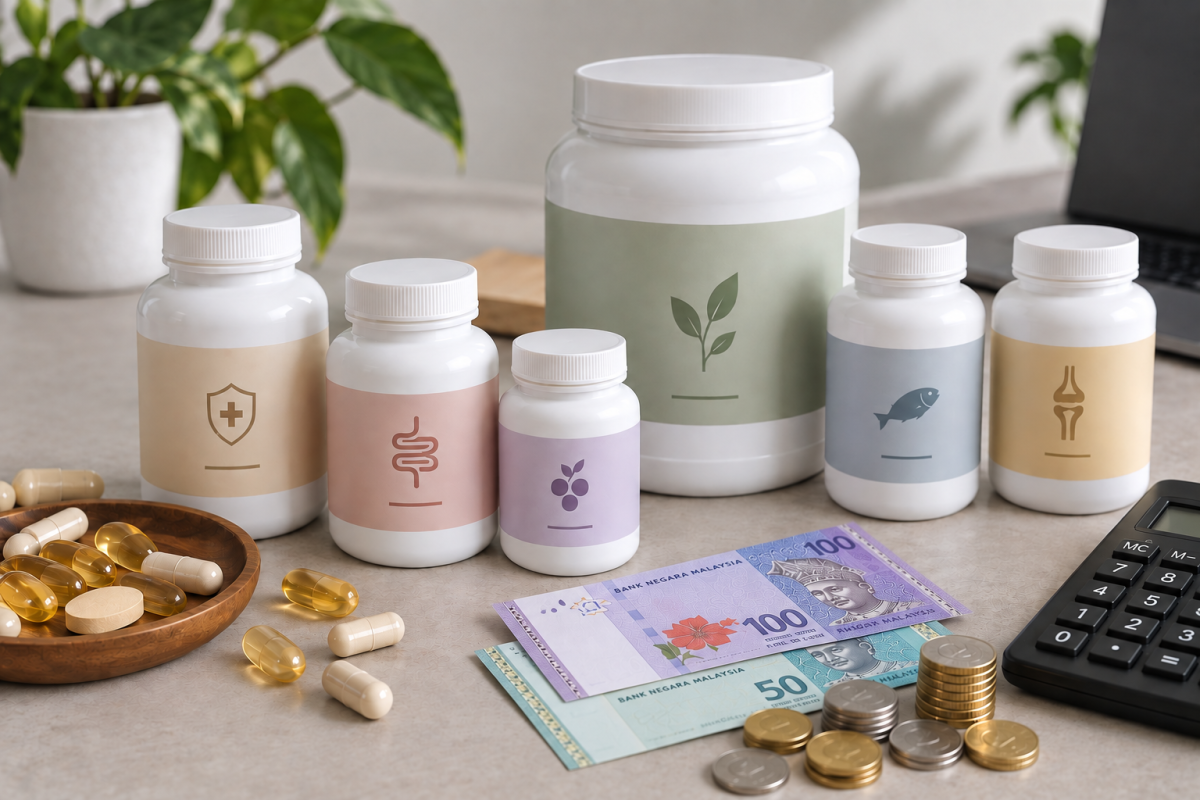
1. Pricing & Profitability
Manufacturing costs directly affect your selling price and profit margin. However, the true cost of a supplement also includes marketing, fulfilment, platform fees, and other operating expenses.
2. Strict Regulatory Requirements
In Malaysia, supplement businesses need to consider product classification, registration, manufacturing standards, labelling, claims, and post-registration obligations. Compliance should be built into the product development process from the start, rather than treated as a final step.
Building compliance into the product development process from the start helps avoid costly delays, revisions or compliance issues later.
3. Raw Material Price Changes
Ingredients, packaging and freight costs can change due to supplier pricing, availability and exchange rates, affecting your margins even after a product is launched.
For this reason, avoid basing your pricing strategy on an assumed manufacturing cost. Confirm current pricing and understand how potential cost changes could affect your margins.
4. Hidden Fees
The manufacturing quote may not cover expenses such as testing, packaging, artwork, freight, storage, regulatory services, fulfilment and payment processing. These additional costs can quickly add up and affect your overall launch cost.
5. Premiumisation and Product Positioning
Malaysia’s supplement market is seeing interest in more specialised categories, including probiotics, minerals, beauty and cellular health. This creates opportunities for brands that offer clear differentiation and strong product positioning.
However, premium pricing needs to be supported by product quality, formulation, packaging, and credible positioning. A higher price alone does not make a product premium.
How to Start Your Own Supplement Company

1. Define Your Niche
Start with the customer and commercial opportunity, rather than the ingredient. Identify who the product is for, what need it addresses, which format suits the target customer, what price point is realistic, which competitors already serve the market, and how your product will differentiate itself.
A specific target market gives you a clearer foundation for product development, positioning, and marketing than trying to create a supplement for everyone.
2. Create a Business Plan
Build a plan that connects the product to the economics. Do not calculate profitability using only selling price minus manufacturing cost, as customer acquisition, payment fees, discounts, returns, salaries, and overhead can materially affect your actual margins.
3. Choose the Product Development Model
Decide whether private label, OEM, custom formulation, or another model fits your supplement business objectives. If differentiation is not yet proven, private label can allow faster market testing, while a custom formulation may be worthwhile when the business has identified a clear product gap.
4. Find a Suitable Manufacturer
Evaluate manufacturers based on more than unit price. Evaluate manufacturers based on quality, capabilities, costs, lead times, and scalability. The cheapest quotation may become more expensive if it comes with poor communication, inconsistent quality, or inflexible MOQs.
5. Develop and Test the Product
Move through formulation, sampling, and testing before committing to a major production run. This is when product changes are generally easier to manage, whereas changing a formula after packaging or inventory has already been produced can be considerably more disruptive and costly.
6. Address Regulatory Requirements
Confirm product classification, registration requirements, documentation, labelling and advertising considerations early in the process. For Malaysia, NPRA provides a defined product registration process covering preparation, submission, evaluation and post-registration activities.
7. Build the Brand and Sales Channel
Turn your product into a brand customers can recognise and trust through strong packaging, a clear website and focused marketing. Then choose the sales channels that best fit your target market, whether that means e-commerce, marketplaces, pharmacies, distributors or B2B sales.
8. Launch, Measure and Reorder Carefully
Look beyond sales and track customer acquisition, conversion, repeat purchases, margins, and inventory performance. Use these insights to decide whether your next production run should be larger, smaller, or reformulated.
Common Mistakes When Estimating Supplement Manufacturing Costs
- Looking Only at the Cost Per Unit: A manufacturer might quote an attractive unit price, but the total cash requirement can include MOQ, packaging, testing, freight, regulatory services, and other expenses.
- Underbudgeting Marketing: Producing a high-quality supplement does not guarantee sales. The business needs sufficient resources to introduce the product, acquire customers, and test which channels actually work.
- Launching Too Many SKUs: Multiple products multiply formulation, packaging, inventory, registration, marketing, and operational requirements. A focused initial range can make it easier to learn what customers actually want.
- Comparing Manufacturers Only on Price: A supplier’s quality systems, MOQ, lead time, documentation, testing, communication, and ability to scale can be just as important as the quoted manufacturing price.
What Are the Top Supplement Trends in 2026?

Several trends are particularly relevant when evaluating new supplement concepts in 2026.
- Multi-Benefit Products: Consumers may prefer products that fit several parts of a routine rather than requiring multiple separate products. For brands, this can create opportunities for thoughtfully formulated combination products, provided the formulation and claims are appropriate.
- Routine-Friendly Formats: Convenience remains commercially important. Formats such as stick sachets, powders, ready-to-use products, and simplified daily routines can help differentiate a product beyond its ingredient list.
- Science-Backed Positioning: A growing focus on science and proven benefits means businesses need to pay more attention to ingredient quality, dosage, evidence, and how they communicate product claims.
- GLP-1 and Metabolic Health: GLP-1 medications are creating new interest in the broader area of metabolic health. However, brands should be careful not to treat GLP-1 as a shortcut to a weight-loss marketing strategy. Product positioning and claims still need to comply with the relevant regulatory requirements.
Conclusion
The cost of starting a supplement company is not determined by the first manufacturing quotation alone. The real investment extends beyond production to include developing the product, meeting regulatory requirements, building the brand, acquiring customers, managing fulfilment, and maintaining enough working capital to operate between production cycles.
For new founders, the best approach is to choose a model that fits their budget, start with a focused product range, build in compliance, and validate demand before scaling. If you’re ready to take the next step, whether you need white-label or private-label OEM, turnkey manufacturing, or a custom formula, our team at LIQ Formulations is here to help. Contact us today to discuss the right fit for your business.
Frequently Asked Questions
1. How much money do you need to start a supplement company?
The cost depends on the business model:
- Private-label / white-label dropshipping: RM10,000–RM40,000
- OEM supplement manufacturing: RM40,000–RM120,000
- Custom formula development: RM80,000–RM250,000+
- In-house manufacturing: Significantly higher, due to facilities, equipment, staff, and manufacturing systems.
2. How profitable is a supplement business?
A supplement business can be profitable, and Malaysia’s market shows strong growth potential.
According to the Malaysian Dietary Supplement Association, Malaysia’s supplement market reached RM5.48 billion in 2025, growing at around 8% annually from 2020 to 2025, and is projected to reach RM6.5 billion by 2030.
3. How can I start my own supplement brand?
Start by defining your target market, researching competitors, choosing a product concept, selecting a manufacturer, developing and testing the product, addressing regulatory requirements, and building your brand and sales channels.
4. What are the most bought supplements?
Commonly purchased supplement categories include products containing vitamin D, omega-3 fatty acids and magnesium, alongside multivitamins, probiotics and other category-specific products.
For a business, however, popularity alone is not enough to determine what to launch. A heavily competitive category may be harder for a new brand to enter than a smaller category with a clearly identifiable customer need.