
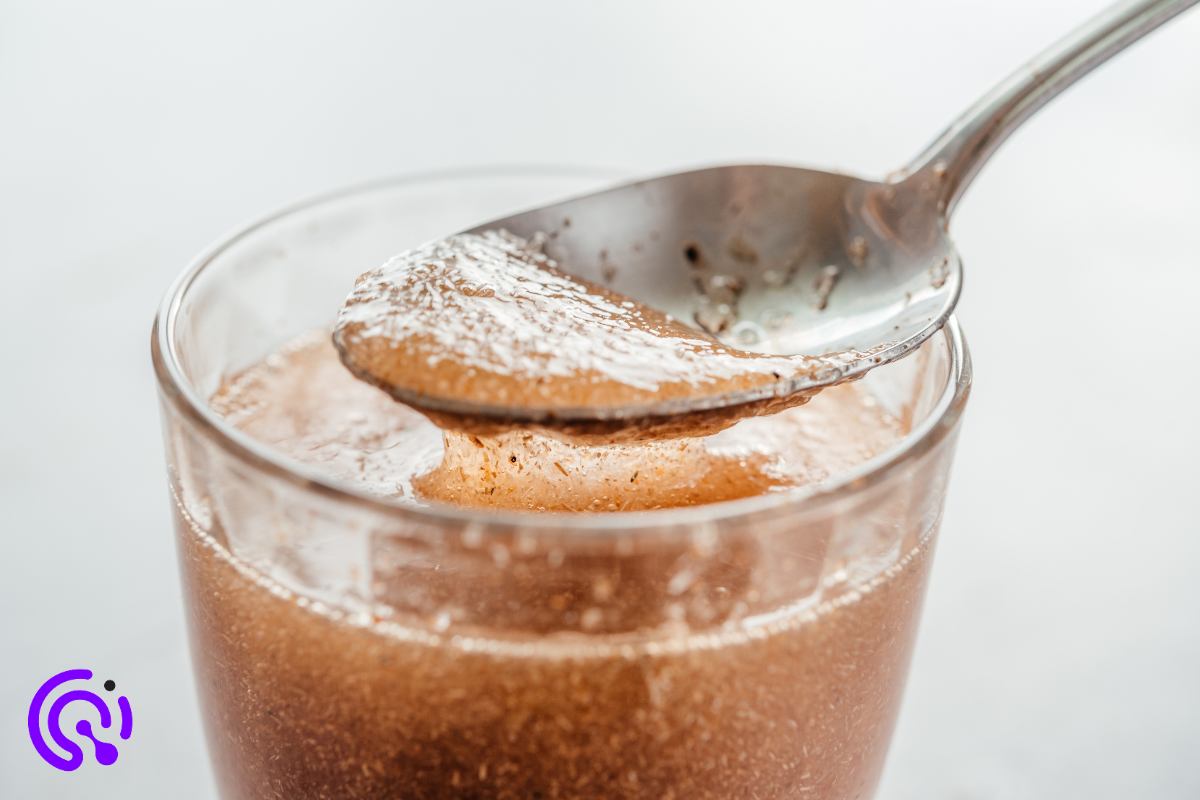
Why Does Fiber Make Some Supplement Drinks Thick?
If you have ever developed a fiber supplement drink, you may have noticed that adding fiber can change more than just the nutritional profile.
The drink may become:
- Thicker
- Smoother
- More viscous
- Slightly gel-like
- Harder to mix
So, why does this happen?
The simple answer is:
Some types of fiber absorb or interact with water in a way that increases the thickness of the drink.
But not all fibers behave the same way.
For supplement brand owners, understanding this is important when deciding on the right fiber ingredient, dosage and product format.
What Does “Viscosity” Actually Mean?
Viscosity simply describes how easily a liquid flows.
Water has low viscosity, so it flows easily.
Honey has much higher viscosity, so it flows more slowly.
When we talk about a fiber supplement becoming “thick,” we are essentially talking about an increase in its viscosity.
The important thing is that different fibers can produce very different levels of viscosity.
A drink containing one type of fiber may still feel light and easy to drink, while another may become noticeably thick at the same dosage.
Why Does Fiber Increase Viscosity?
Many soluble fibers interact with water.
Depending on the type of fiber, they may dissolve, hydrate, swell or form a more structured solution.
As this happens, the movement of water becomes more restricted, resulting in a thicker texture.
A simple way to think about it is:
Fiber + Water → Hydration → Increased viscosity
However, the amount of thickening depends on the type and concentration of fiber.
This is why “soluble fiber” does not automatically mean “thick drink.”
Not All Fibers Behave the Same Way
This is one of the most important considerations in fiber supplement formulation.
Some fibers are naturally more viscosity-building than others.
For example, psyllium is known for its ability to absorb water and form a viscous material.
Other soluble fibers may be much lighter in texture and can be more suitable when the goal is a drink that remains relatively easy to mix and consume.
So when choosing a fiber, the question shouldn’t simply be:
“Which fiber has the most benefits?”
It should also be:
“How will this fiber behave in my finished product?”
More Fiber Can Mean More Texture
The amount of fiber used also matters.
A formulation containing a small amount of a viscosity-building fiber may still produce a drinkable texture.
Increase the dosage significantly, and the same ingredient may create a much thicker product.
This becomes particularly relevant for high-fiber supplements.
For example, a brand may want to provide a high amount of fiber per serving while still maintaining a light, refreshing drinking experience.
Those two objectives may require careful consideration during formulation.
Why Does My Fiber Drink Become Thicker After Mixing?
Sometimes the drink looks fine immediately after mixing but becomes thicker after a few minutes.
This can happen because the fiber continues to hydrate after it is added to water.
This is why it is useful to assess a fiber drink not only immediately after mixing, but also after it has been allowed to stand.
For a consumer product, the actual experience might be:
Mix → Drink immediately
versus
Mix → Leave for 5–10 minutes → Drink
The texture may not be identical.
Why Does Fiber Powder Sometimes Clump?
Viscosity isn’t the only consideration.
Some fibers hydrate quickly when they come into contact with water. If the powder is not dispersed properly, the outside of the particles can hydrate first, causing lumps to form.
This can result in the familiar:
“I mixed my supplement and now there are chunks floating in it.”
The issue may be influenced by:
- Fiber type
- Particle size
- Powder composition
- Mixing method
- Amount of water
- Hydration speed
This is particularly important for powder supplement formulation, where consumers are expected to mix the product themselves.
The Rest of the Formula Matters Too
Fiber doesn’t behave in isolation.
The final texture can also be affected by other ingredients in the formulation.
For example, a fiber drink containing:
Fiber + Minerals + Acids + Flavour + Sweetener
may behave differently from:
Fiber + Water
Factors such as pH, mineral content and the concentration of other ingredients can influence the final viscosity and mouthfeel.
This is why a fiber ingredient that performs well in one product may not behave exactly the same way in another.
What Should Supplement Brand Owners Consider?
When developing a fiber supplement, it helps to define the desired product experience first.
Ask:
How much fiber do we want per serving?
A higher fiber dose may create greater formulation challenges.
Should the drink be light or thick?
A smoothie-style product has very different texture expectations from a clear functional beverage.
How quickly should it mix?
For a sachet powder, consumers generally expect the product to disperse easily.
How much water will consumers use?
The same amount of fiber can behave differently depending on the amount of water used.
What other ingredients are in the formula?
Minerals, acids, proteins, botanicals and other functional ingredients can affect the final product.
There Isn’t One “Best” Fiber
Choosing a fiber for a supplement isn’t simply about finding the ingredient with the longest list of benefits.
The right choice depends on the complete product concept.
Consider:
Fiber type
↓
Target dosage
↓
Product format
↓
Desired texture
↓
Mixing & stability
↓
Consumer experience
For example, a fiber powder designed to be mixed into a smoothie can tolerate a very different texture from a light, refreshing fiber drink.
The formulation needs to work for the product you actually want to create.
The Takeaway
Fiber can make a supplement drink thicker because certain fibers interact with water and increase the liquid’s resistance to flow.
But not all fibers have the same effect.
When developing a fiber supplement, consider more than just the amount of fiber per serving.
Look at:
- Fiber type
- Dosage
- Solubility
- Hydration
- Mixing behaviour
- Other ingredients
- Desired mouthfeel
- Final product format
Ultimately, the “right” fiber is not just the one that looks good on the ingredient list.
It is the one that works for the nutritional goal, formulation and drinking experience you want to deliver.
Frequently Asked Questions
Does all soluble fiber make drinks thick?
No. Different soluble fibers have different viscosity and hydration properties. Some can produce a relatively light drink, while others create a much thicker texture.
Why does my fiber drink get thicker after mixing?
Some fibers continue to hydrate after being added to water, so the viscosity can increase over time.
Why does my fiber powder clump?
Rapid hydration, poor dispersion, particle size and mixing conditions can all contribute to clumping.
Can a high-fiber drink still be light and easy to drink?
Yes, depending on the fiber selected, dosage and overall formulation. Fiber selection is therefore important when developing a light beverage.
What should I consider when choosing a fiber for a supplement?
Consider the fiber type, target dosage, solubility, viscosity, mouthfeel, mixing behaviour and the final product format not just the nutritional benefits.